How I read the Vera Sibilla and Why Its History Matters
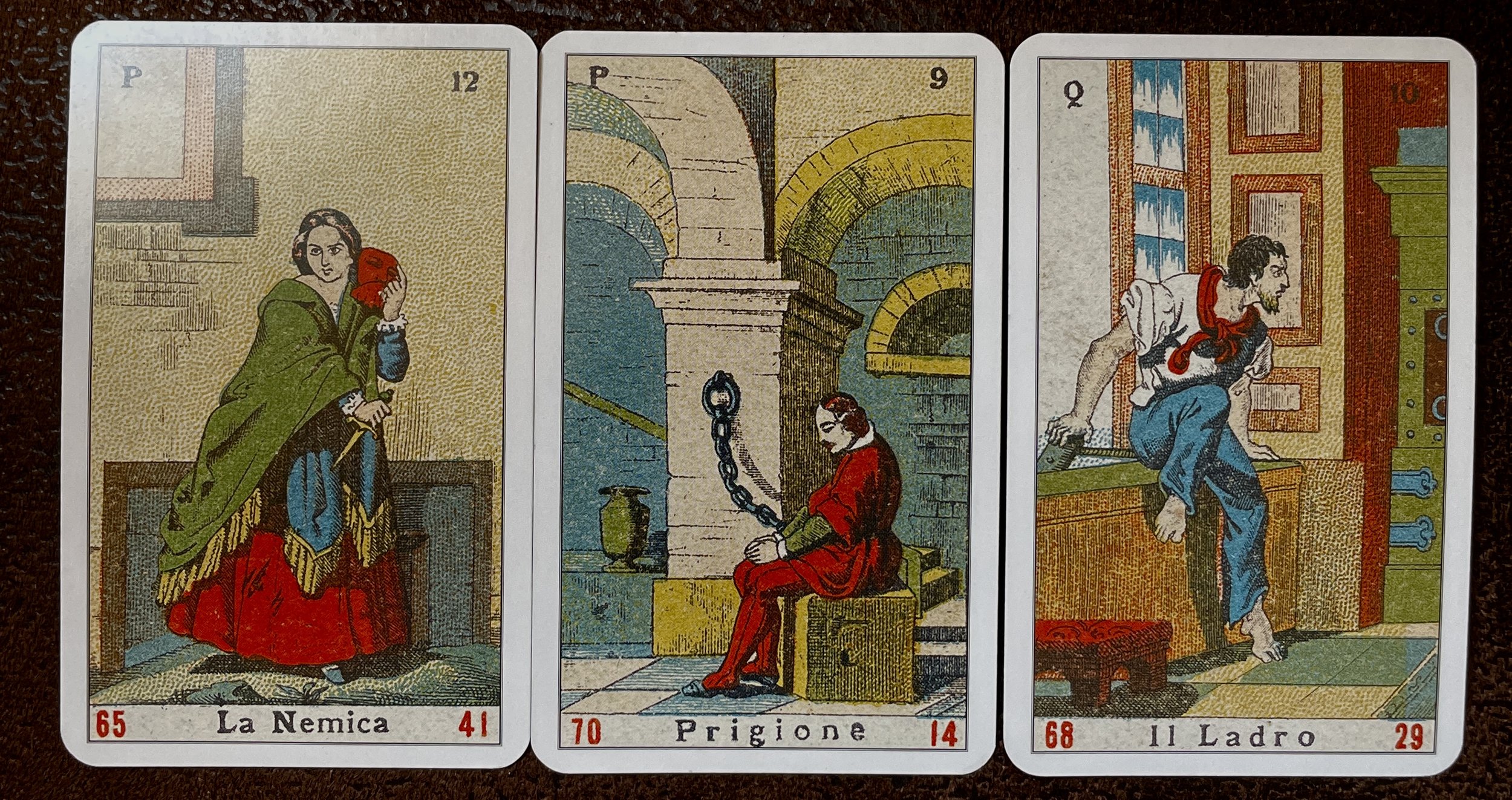
Vera Sibilla is a traditional Italian 52-card deck.
Italy’s everyday oracle carries an ancient name and a surprisingly young deck. That contrast is the point: the gap between appearance and reality is what gives the Sibilla its power in a reading. This honesty lets the deck offer practical, straightforward guidance instead of empty promises, so clients can receive answers that genuinely help them move forward. In other words, seeing the Sibilla for what it truly is opens the door to real insight.
Two questions come up almost every time someone learns I read the Vera Sibilla. Is it an ancient Italian tradition? And does it tell the future? The honest answers are “not in the way you think” and “not in the way you’re hoping.” That answer matters because the deck’s real value depends on seeing what it is, not what the myth says it is. When you have a reading, you are not handed a prediction set in stone. Instead, you receive honest insight into your situation, practical guidance for your next steps, and the clarity to reflect on what matters most to you. The experience is about finding perspective and support, so you can decide your way forward with a new understanding.
Here is the short version. The name is genuinely old, old enough to reach a cave near Naples and the floor of the Roman Senate. The cards are not. They are a nineteenth-century commercial product from northern Italy, built on the ordinary deck of playing cards and a French fashion for reading fortunes with them. Those two facts are the whole argument: the Sibilla is more interesting and more honest when it is understood as a deck with an old name, not an artifact pretending to be older than it is.
A name much older than the deck
A sibyl, in the ancient world, was a prophetess attached to a place. The most famous sat at Cumae, the early Greek colony near modern Naples. Virgil gave her the scene everyone remembers: in Book VI of the Aeneid, she guides Aeneas into the underworld and delivers her prophecy in a state of divine possession, the god driving the words from her. Her answers came true and were almost useless at the moment of speaking, written on leaves that the wind scattered before the seeker could read them in order. That detail is the one I keep coming back to. The Cumaean Sibyl didn’t hand over tidy predictions. She produced disordered, ambiguous counsel that the person who asked had to gather up and interpret.
Rome treated her as a civic institution. The legend told by Aulus Gellius and Dionysius of Halicarnassus has her selling the last king of Rome three books of prophecy, after burning six others in front of him to keep the price high. Those Sibylline Books were kept in the Temple of Jupiter on the Capitoline and consulted by the Senate only in emergencies until a fire destroyed them, along with the temple, in 83 BCE. Later, Christianity kept the sibyls rather than throwing them out. Varro had counted ten; medieval tradition rounded the number to twelve; Michelangelo painted five of them across the Sistine Chapel ceiling between 1508 and 1512, seated among the Hebrew prophets as their equals. This is the weight the word Sibilla carried. It was never a casual label for a woman who reads cards at a kitchen table.
The cards are young, and that’s the good news.
The deck itself hides its age in plain sight once you know what to look for. It is built on the skeleton of a playing-card pack: fifty-two cards, four suits of thirteen. Each card shows a small scene from ordinary Italian life, a bride, a widow, a letter, a visitor, a windfall, a sickbed, with an Italian caption beneath it and a suit symbol in the corner. The court cards run eleven, twelve, and thirteen, with descriptive titles instead of Jack, Queen, and King. Most editions print lottery numbers on the cards too, because the deck lived beside the gioco del lotto and readers used it to suggest numbers to play. Italian readers call the cards chiacchierine, little chatterboxes, because they answer bluntly and tend to say more than they were asked.
The real ancestry of this reading style is French, not Egyptian or Cumaean. Reading fortunes from a deck became fashionable in Paris in the 1770s, when Jean-Baptiste Alliette, working under the name Etteilla, published a system for reading ordinary playing cards with fixed meanings and coined the term “cartomancy.” By his own account, he learned the craft from three card-readers, one of them from Piedmont in northern Italy. His contemporary, Antoine Court de Gébelin, then attached the whole business to a fantasy about ancient Egyptian priests, a claim with nothing to back it that influenced occult thinking for two centuries. The historian William G. Pooley has shown that most nineteenth-century readers ignored the esoteric decks entirely and worked with a plain fifty-two-card pack, reading through the meanings that Etteilla’s cheap manuals had spread (https://academic.oup.com/fh/article/37/4/379/7310795, French History, 2023). That everyday practice, a playing-card deck with meanings attached, is what the Vera Sibilla grew out of.
The physical trail is commercial and datable. One firm anchor is a fifty-two-card deck printed by L. Lamperti of Milan in 1890, later reissued in facsimile by Il Meneghello, which has also produced a version keyed to an 1850 edition. Modiano of Trieste printed a small Cartomanzia deck in the twentieth century, and Masenghini of Bergamo still prints La Vera Sibilla today, which is why you can buy one over the counter in Italy at all. These are cheap, mass-produced objects, sold beside cigarettes and lottery slips, and their history is domestic and largely female. Italian women were reportedly still bringing their Sibilla decks to Mass for a blessing into the 1970s, despite the Church’s long disapproval. You’ll sometimes read that the deck descends from Austro-Hungarian “Gypsy cards,” a claim worth treating with care, both because it rests on oral and single-source genealogy and because the label shows a nineteenth-century habit of crediting card-reading to a romanticized outsider. What the evidence actually supports is simpler: the Sibilla is a northern Italian synthesis of the fifty-two-card structure and the Etteilla meanings, dressed in scenes of Italian daily life and crowned with the oldest authoritative name available.
How it differs from tarot and Lenormand
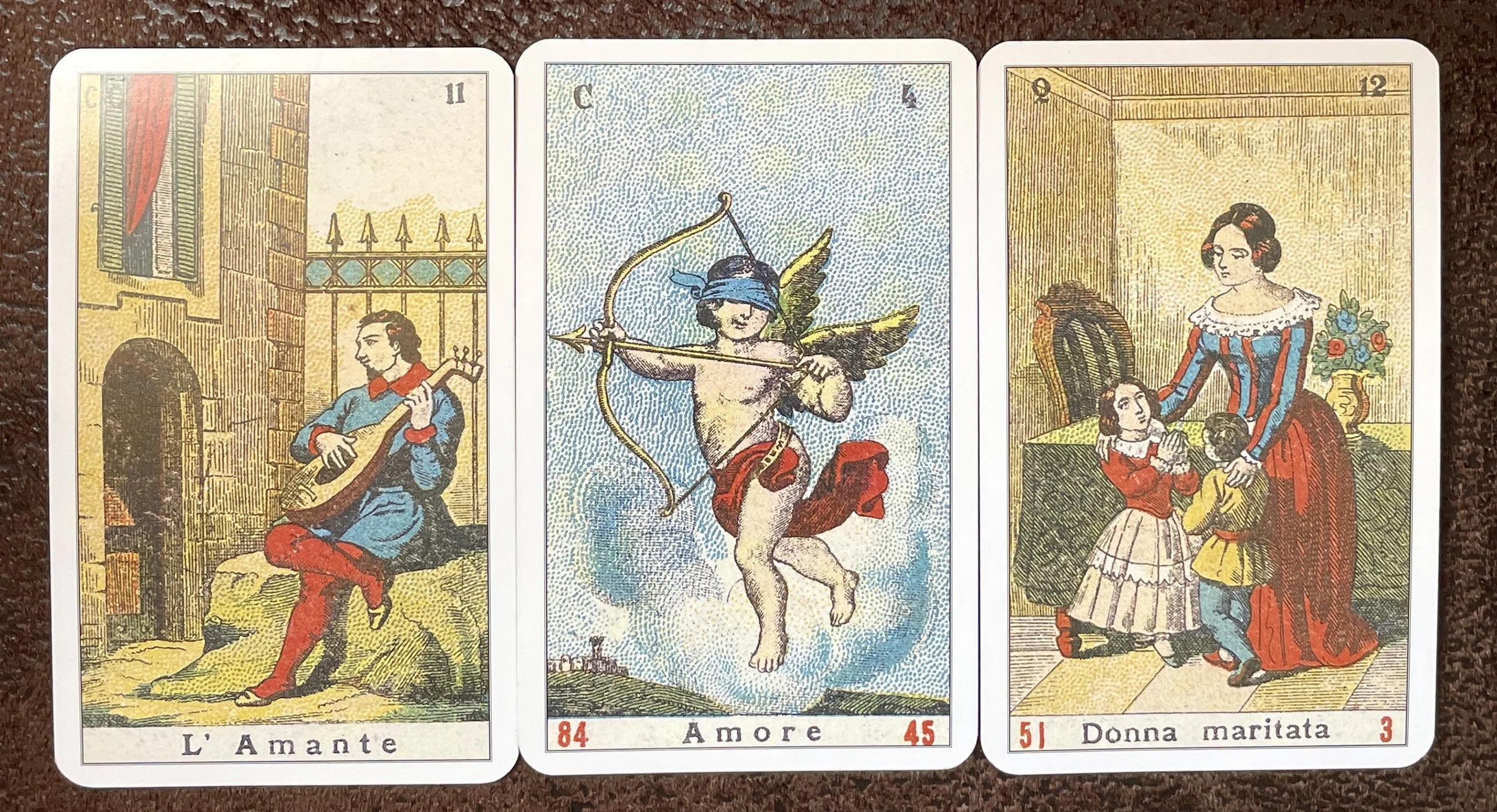
Vera Sibilla cards can be used for introspection for a deeper understanding of your challenges.
People who already read cards often want to know where the Sibilla sits next to the two systems they know. The differences are practical, and they shape what each deck is good for.
Tarot is seventy-eight cards, twenty-two of them the symbolic majors, and it began life in Renaissance Italy as a card game before it became a tool for divination in that same French moment. It works through archetype and image, which makes it strong for reflection on themes, patterns, and the shape of a longer chapter in someone’s life. It rewards sitting with a card.
Lenormand is thirty-six cards, terse and literal, named after the celebrated Paris fortune-teller Marie Anne Lenormand and popularized after her death in the 1840s. It is read in combinations and lines rather than one card at a time, and it excels at concrete, situational detail: who, what, where, the practical mechanics of a matter.
The Vera Sibilla sits closest to Lenormand in temperament, and further from tarot. It is more direct than either. Its scenes name specifics, a rival, a letter, a sum of money, a person who has gone quiet, and it reads a card differently upright and reversed, which nearly doubles its vocabulary. Where tarot prompts thought, and Lenormand reports facts, the Sibilla talks. That bluntness is its signature and, handled well, its strength.
Why I read it as counsel, not a forecast
I keep the Sibilla on my table for the same reason I described its history so carefully. The deck’s honest inheritance isn’t a hotline to the future. It is a way of taking a real question, giving it structure and chance, and then interpreting it yourself. That is the claim I want the history to support.
Read that way, the deck’s directness becomes an asset rather than a threat. When a card names a rival or a delayed letter or money coming in, it isn’t sealing your fate. It is describing a situation clearly enough that you can think about it, and then handing the meaning back to you to work out against your own life. That is exactly what the priestess at Cumae did, and it is the one thing the Vera Sibilla can claim with a straight face. A reading with me is built on that idea. You bring the question that actually matters; the cards give it shape; and we talk through what you want to do about it. In a typical session, we start with your real question, lay out the cards together, and discuss how their images and meanings shed light on your situation. You'll have time to ask follow-up questions and reflect, so you leave with practical counsel and a sense of next steps. If that is the kind of counsel you are looking for, you can book a session here.
The name is far older than the cards. The habit of bringing a hard question to an oracle and leaving with something to interpret is older still. That is the deck’s real function once you stop asking it to be an artifact and let it be a mirror.
A few of the sources behind this piece, for anyone who wants to check the history: A. L. Palmer on Lorenzo Spirito’s fifteenth-century Italian lot-books in https://www.journals.uchicago.edu/doi/10.1086/SCJ4703002The Sixteenth Century Journal (2016); William G. Pooley on nineteenth-century French card-reading in https://academic.oup.com/fh/article/37/4/379/7310795French History (2023); Decker, Depaulis, and Dummett, A Wicked Pack of Cards: The Origins of the Occult Tarot (1996); Mary K. Greer’s notes on the origins of cartomancy; and Simon Wintle’s World of Playing Cards for deck history.
For those interested in my background: I have been working with the Vera Sibilla for several years, reading for clients and researching its origins and traditional practice. My approach combines historical study and hands-on experience, bringing together a scholarly understanding of the deck and the practical insight gained from regular use. My goal is to help people get honest, actionable guidance through this remarkable Italian tradition.