Before infinity, there was the hat
How the Lemniscate Entered the Tarot
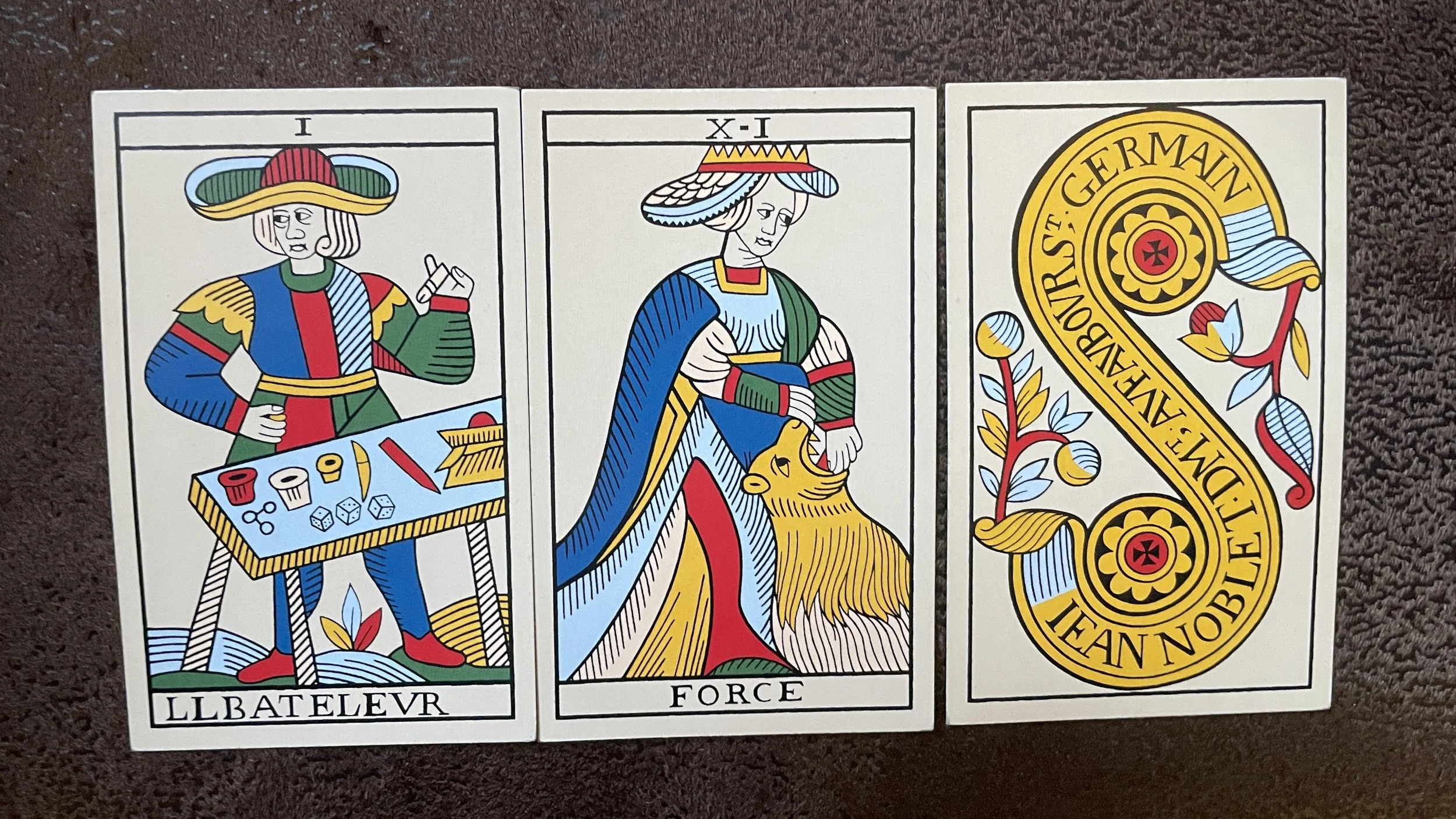
Tarot de Marseille, Jean Noblet version
Look closely at the Magician card in a modern tarot deck. Above the Magician’s head floats ∞ the lemniscate, a sign for infinity. You’ll see it again on the Strength card, above a calm woman opening a lion’s jaw. This symbol links these two Major Arcana cards, but it wasn’t always there. The two of pentacles also shows a man juggling discs inside the infinity symbol. The story of the lemniscate in tarot is a fascinating journey through Western esotericism, involving Roman coins, medieval ribbon designs, French occultists, and a bold 1909 redesign that changed the cards’ meaning.
In Marseille Tarot, the Magician’s hat was, for centuries, just a traveler’s hat. Its brim often arched up on each side and narrowed in the middle, making a shape like a sideways figure-8. These curves were common in fashion then, but, at a glance, seemed to sketch the infinity symbol.
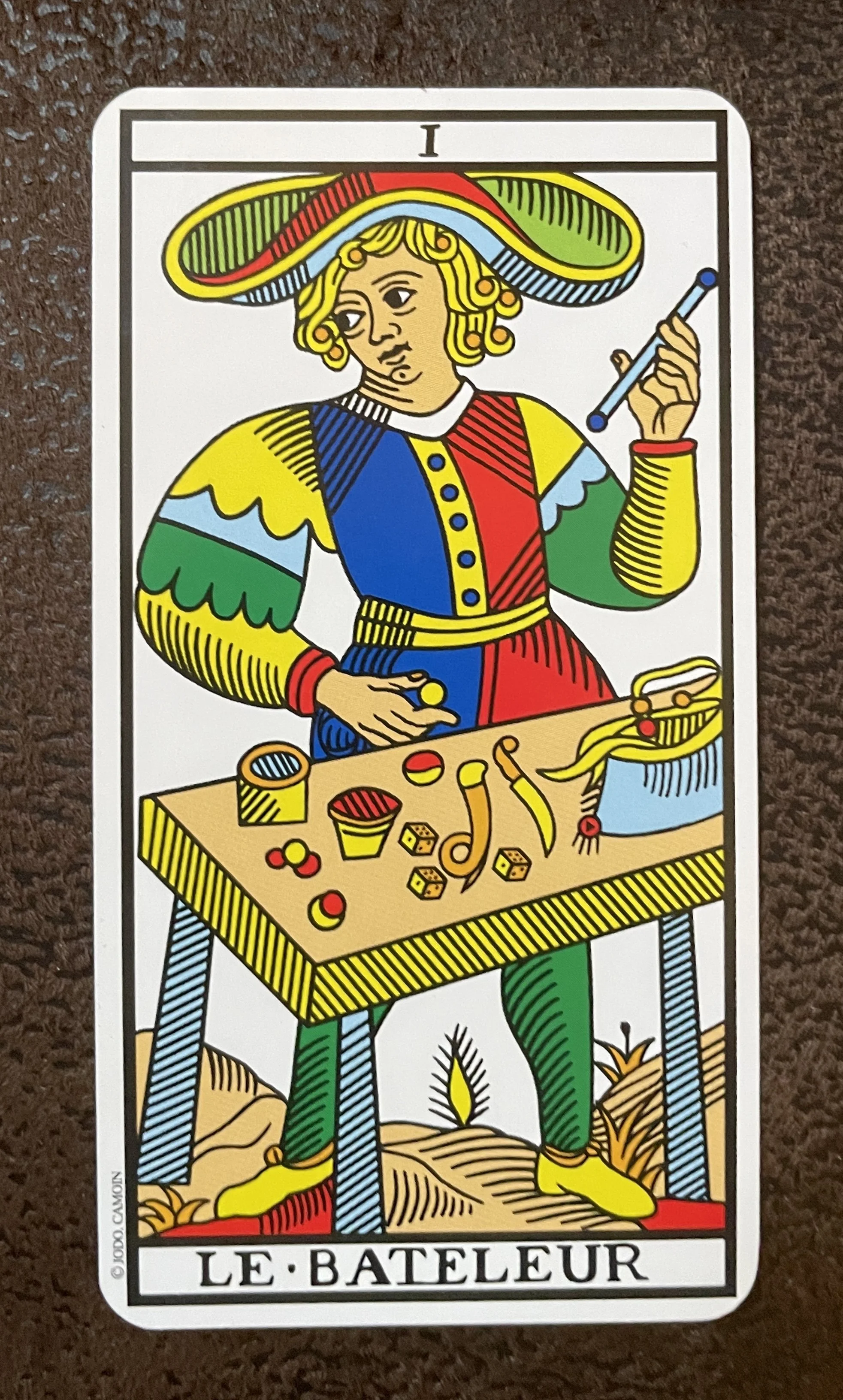
Tarot de Marseille, The Magician (Le Bateleur), Alejandro Jodorowsky-Philippe Camoin version
The Shape Before the Symbol
Ancient traditions: The ouroboros and the Roman numerals
The figure-8 shape has appeared in human culture for thousands of years. The ouroboros, a snake eating its own tail, showed up in Egyptian texts and later in Greek philosophy as a symbol of cycles and renewal. It gives a simple sense of an endless loop. It was not always mathematical; it had a more universal image of infinity.
A closer ancestor of the infinity symbol may have originated in Roman bookkeeping. Before using M, Romans wrote 1,000 as CIↃ or CↃ; these shapes resembled a figure-8 or curved brackets. Over time, scribes adopted these forms to mean 'many' or 'countless.' The figure-8 shape conveyed limitlessness before being called infinity.
John Wallis and the birth of ∞
In 1655, English mathematician John Wallis introduced ∞ in his book De sectionibus conicis. He used it for an unlimited quantity but never explained why. Many think it relates to the Roman CIↃ symbol for 1,000, which means 'as many as you could imagine.' Others think it comes from Greek omega (ω) or a handwritten 8.
For tarot, the important date is 1655. That year, Wallis introduced ∞ almost forty years before Jacob Bernoulli described the lemniscate curve. The symbol and the math came together later, and it took about 250 years for the symbol to appear in tarot.
The Marseille Tarot and the Traveler's Hat
Le Bateleur: the street conjurer
Tarot de Marseille was standardized by the French woodblock printing industry in the 17th century. Its visual traditions come from Italian decks from the 15th century. Here, the first trump card, numbered I, is Le Bateleur, or the Juggler/Conjurer. He is not a magus but a street artist at a table, with cups, coins, a knife, and a ball. He relies on sleight of hand and dexterity.
He wears a wide-brimmed hat. In detailed Marseille decks like Jean Noblet (circa 1650), Jean Dodal (early 18th century), and Nicolas Conver (1760), the brim curves into a figure-8. Some Piedmontese decks, like Lombardy and Soprafino, make this clearer. There’s no proof that the makers intended a symbol. The hat was a detail showing he was a performer, shaped by woodblock styles and fashion. This hat was common for street performers. Its link to infinity was a later occult interpretation.
Le Bateleur was not a magician. He was a street conjurer — and his hat was just a hat.
La Force: the woman and the lion
The eleventh trump in the Marseille decks is La Force, or Strength. The card depicts a woman opening the lion's jaw. Sometimes, she pries open its jaws; sometimes, she holds the mane.
She also wears a hat with a floppy brim, sometimes curved into a figure-8 like the Bateleur’s hat. Both hats link the cards, which are ten apart. During the Marseille period, this link was not a symbol but simply a costume choice.
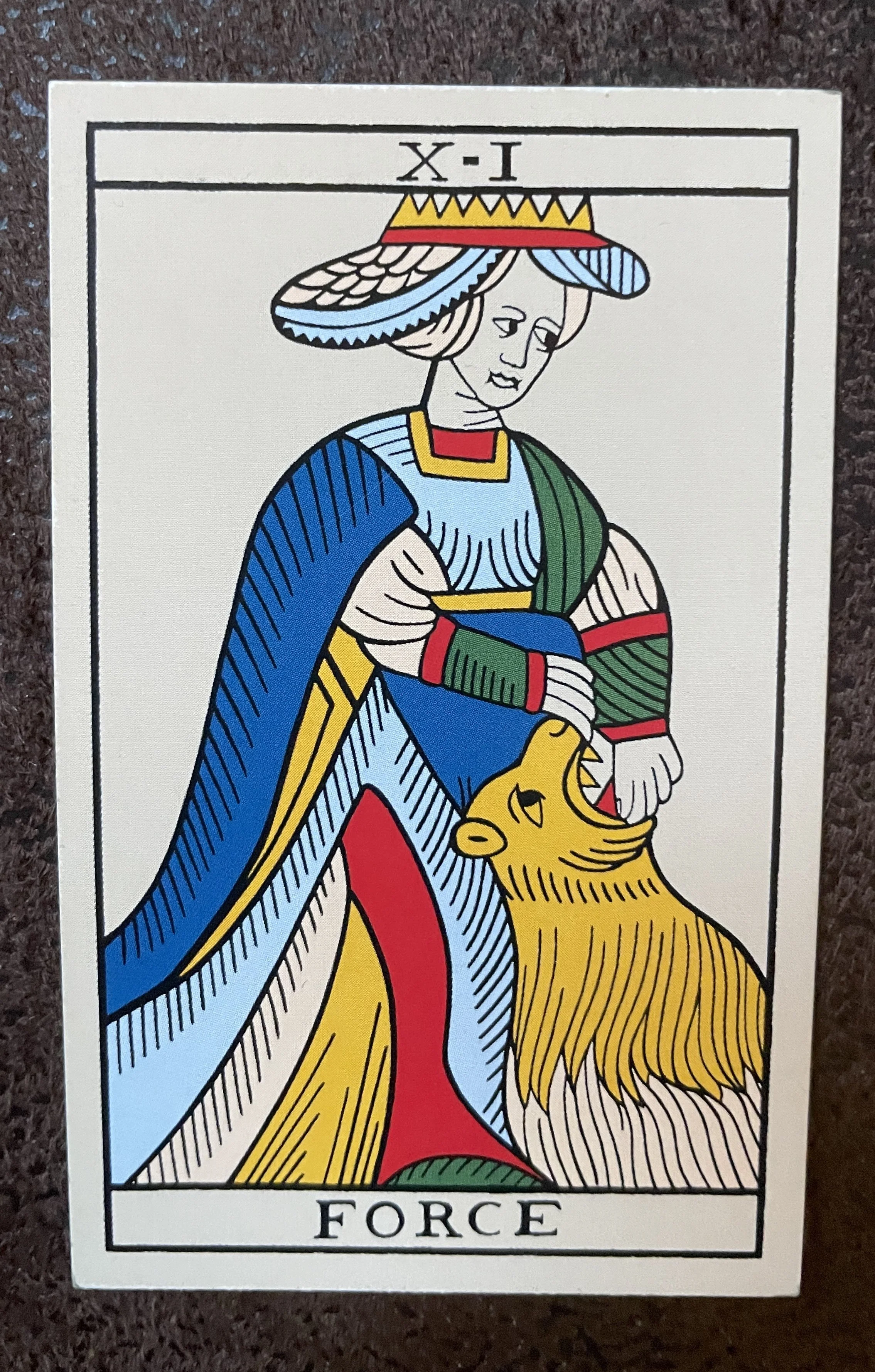
Tarot de Marseille, Strength (Force), Alejandro Jodorowsky-Philippe Camoin version
The Occultists Arrive
Eliphas Levi and the Juggler transformed.
Everything changed in 1855 with the publication of Dogme et Rituel de la Haute Magie (Transcendental Magic) by Alphonse Louis Constant (Eliphas Levi). Levi mapped the Major Arcana onto the Hebrew alphabet, Kabbalah, and Western magic, shaping modern tarot.
In the first card, Levi did something new. He saw the hat’s figure-8 brim as a mystical sign and linked it to the lemniscate, meaning eternal life and infinite will. The street performer became a Magus, and the traveler's hat turned into a halo of infinity.
Levi didn’t redraw the cards, but his interpretation shifted the hat from costume detail to mystical symbol, changing how it was seen.
Oswald Wirth and the visual transformation
In 1889, Swiss occultist Oswald Wirth, with Marquis de Guaita, created a new deck. He aimed to present Levi’s ideas clearly. Wirth’s deck kept Marseille features but made the lemniscate clear. The hat brim is a horizontal figure-8, the infinity symbol. Strength (still XI) has the same. Wirth’s notes tied the symbol to infinity and Masonic ideas.
Wirth’s redesigned Marseille-style deck featured the visible lemniscate, making the mystical symbol easy to spot.
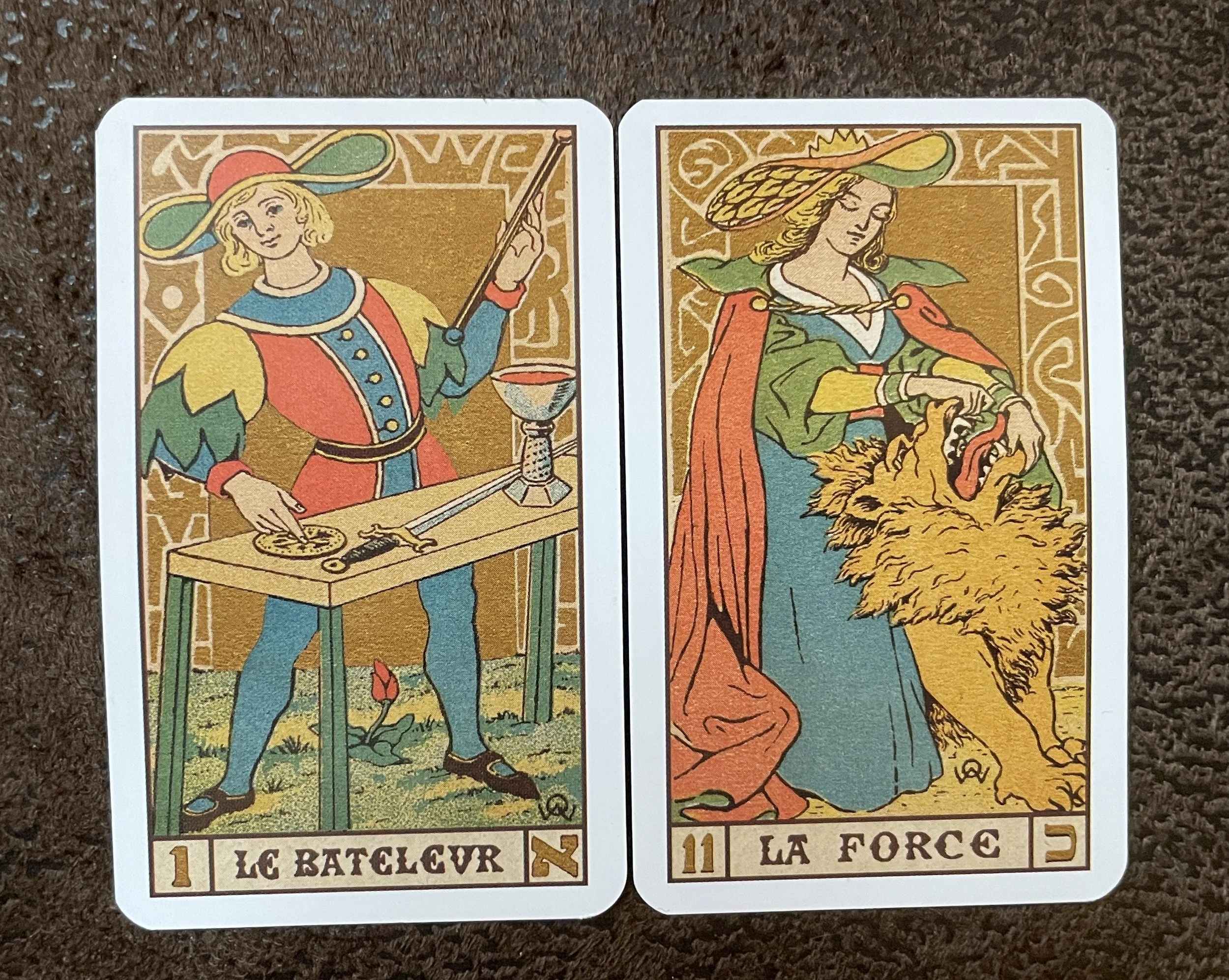
Wirth Tarot, Le Bateleur, La Force
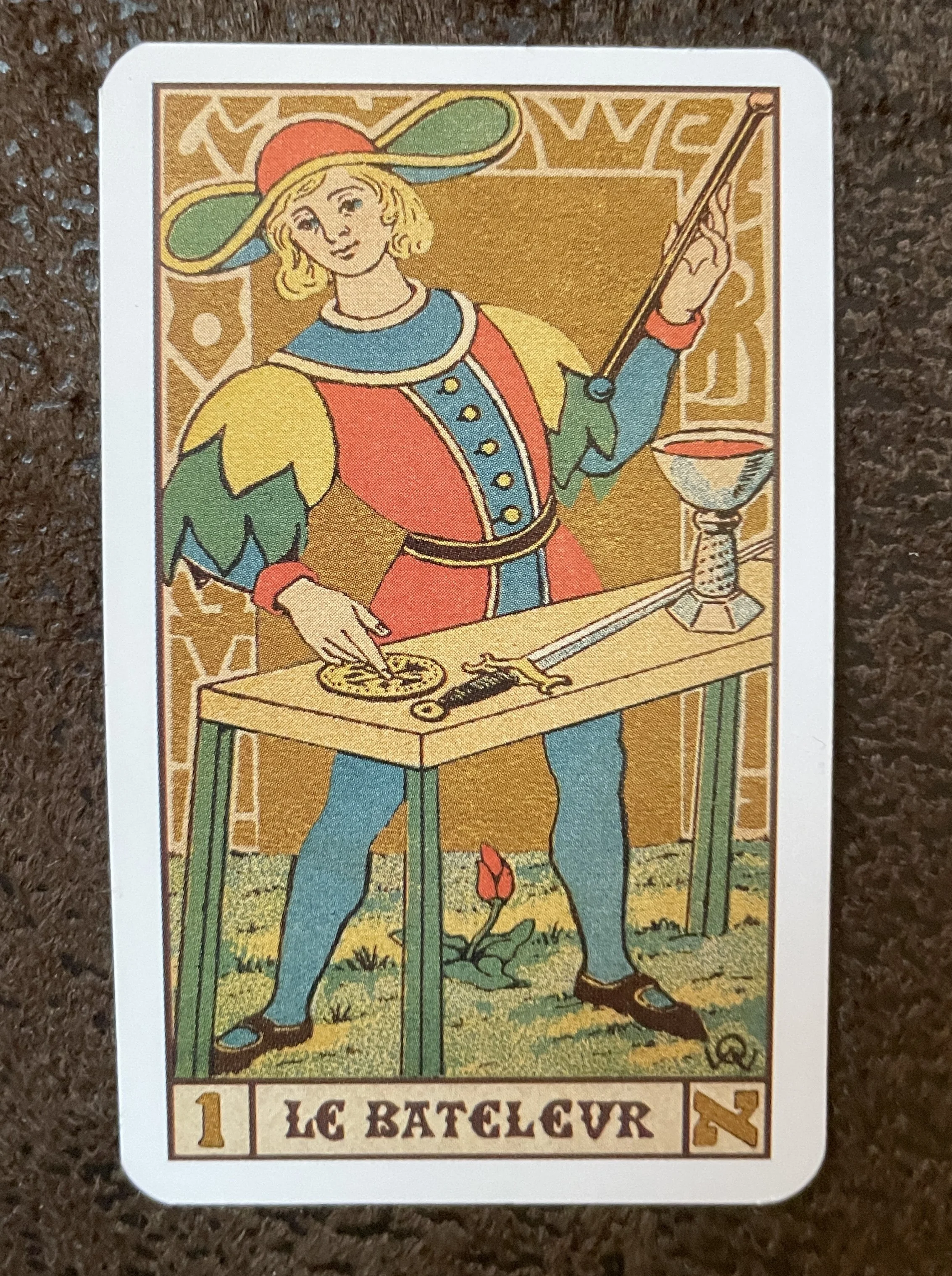
Oswald Wirth Tarot, Le Bateleur
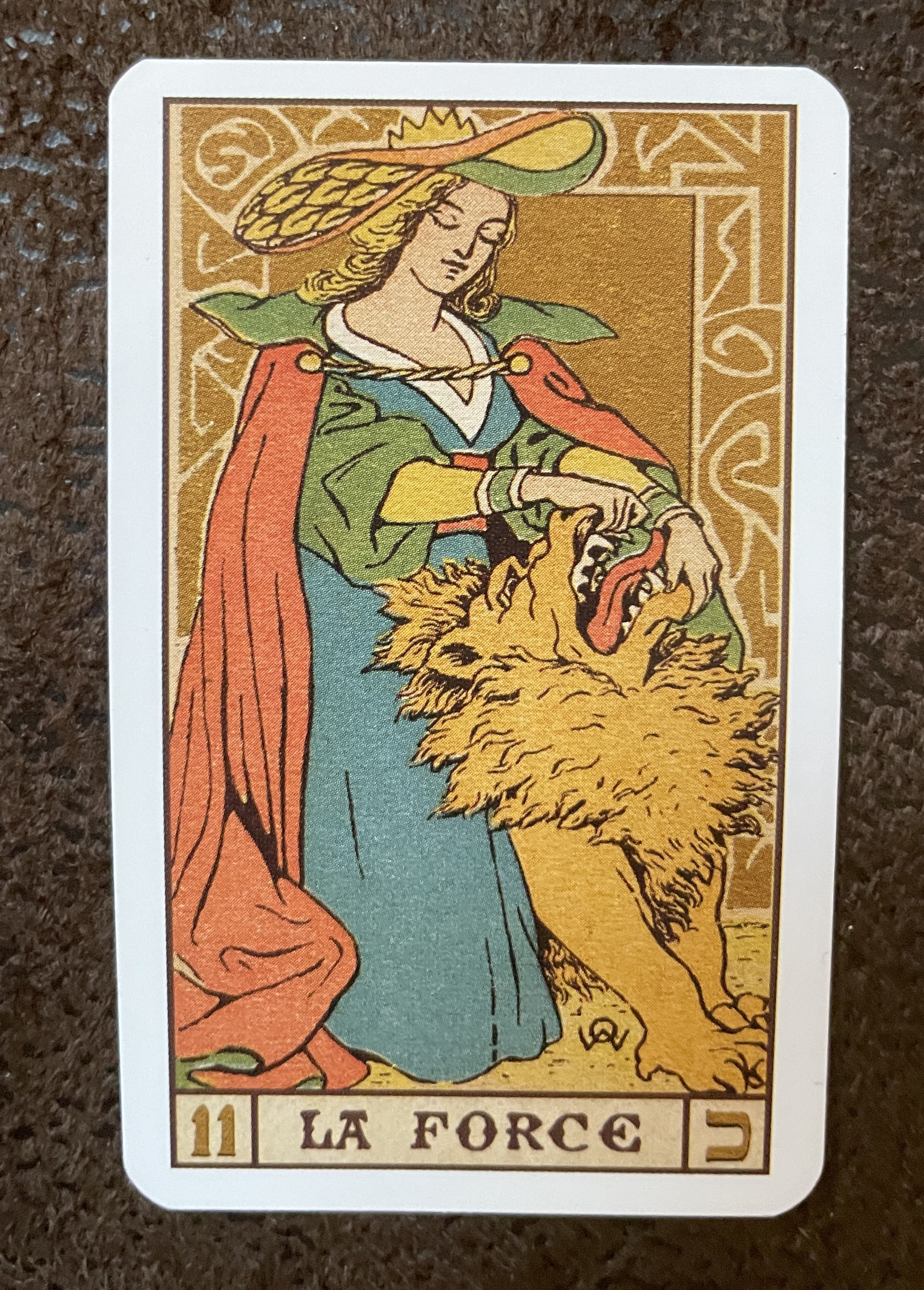
Oswald Wirth Tarot, La Force
The Rider-Waite-Smith Deck and the Great Swap
Pamela Colman Smith makes it float.
In 1909, Pamela Colman Smith, under Arthur Edward Waite, created the most influential deck of the 20th century. Named for its publisher (Rider), architect (Waite), and artist (Smith), this deck made a major change: it removed the hat completely and replaced it with a lemniscate hovering above the magician's and the woman's heads in strength.
With the hat gone, ∞ the symbol floated above, visually united these two cards. It was no longer a part of their clothing but a sign. This made their symbolic connection clear.
Waite explained in his Pictorial Key to the Tarot that the lemniscate above Strength is 'the same symbol of life' found with the Magician. He called it 'the mysterious sign of the Holy Spirit.' For Waite, it showed divine infinity in will and courage. The lemniscate marked the eternal force joining body, mind, and spirit. Waite saw it as a symbol linking earthly action and divine power, hinting at creation’s mystery.
Pamela Colman Smith drew a symbol, not a hat, making visible what had been hidden for so long.
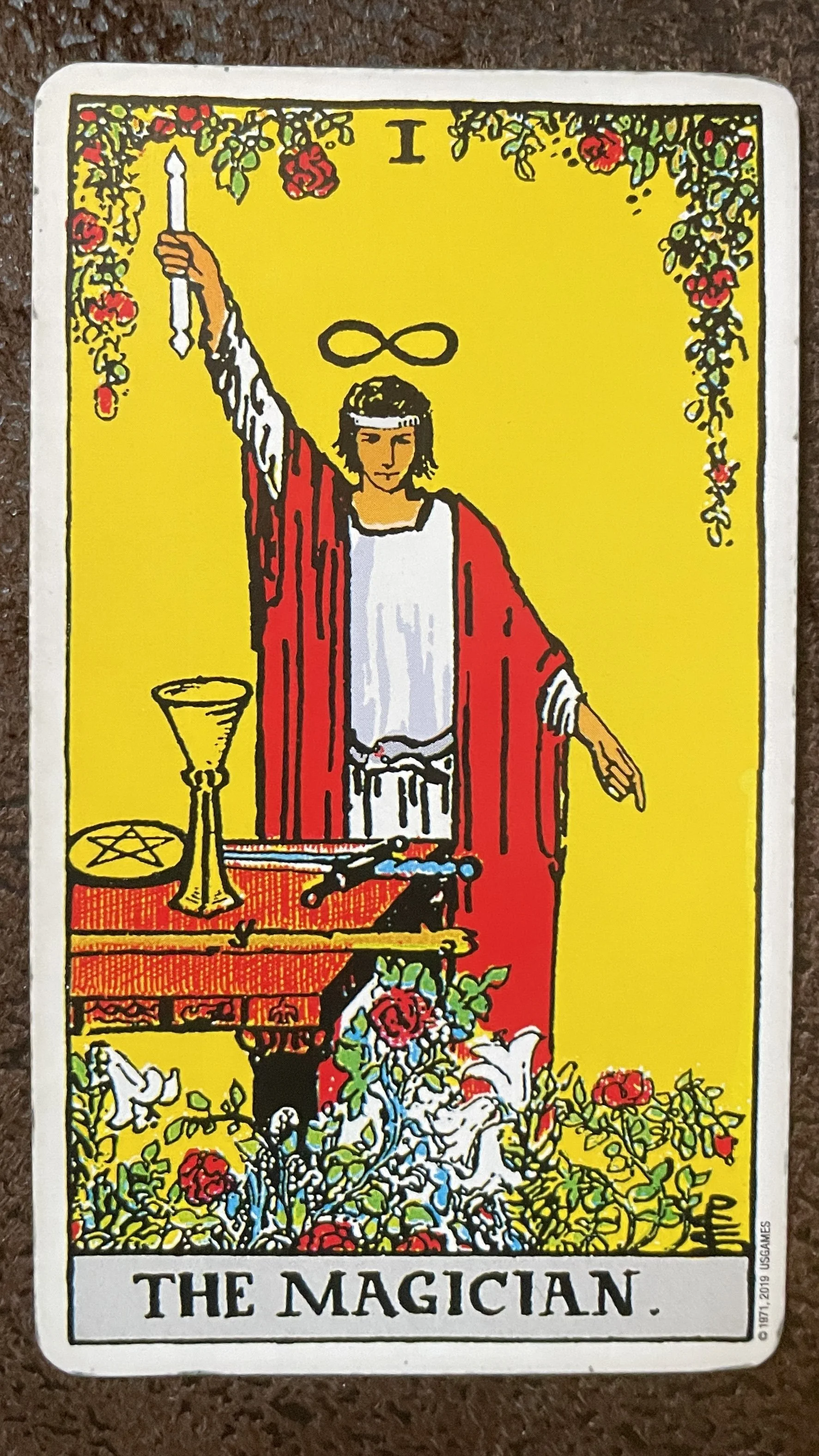
Rider Waite Smith Tarot, The Magician
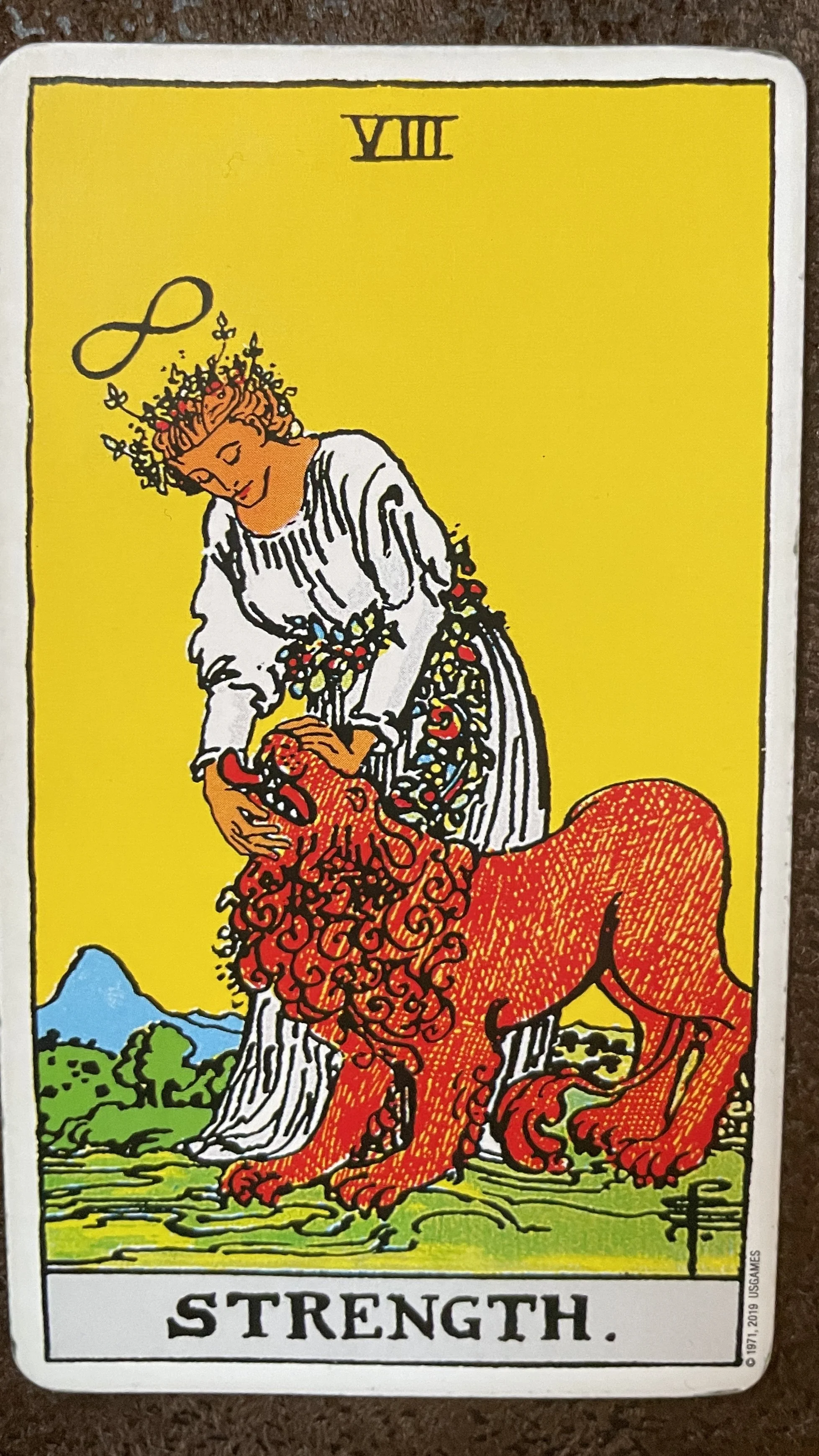
Rider Waite Smith Tarot, The Strength
The controversial swap: why Strength moved to position VIII
Here, the story may surprise RWS readers. In Marseille and pre-Golden Dawn decks, Strength is XI and Justice is VIII. This order is in the Noblet (1650), Viéville (1650), and Dodal (1701) decks. For over two centuries, Strength was XI and Justice VIII.
Waite reversed the order of Strength and Justice in the RWS deck, reassigning Strength to VIII and Justice to XI. He offered only personal reasons for this change.
Later scholars say the real reason was astrological. The Golden Dawn mapped Major Arcana cards to zodiac signs. Strength’s lion matched Leo, the fifth sign, but in their sequence, it fit best at VIII. Justice matched Libra. The swap solved an astrological puzzle for the Golden Dawn.
This change affected the lemniscate. With Strength at VIII, a new symbolism appeared: the number 8 sideways becomes ∞. This link felt intuitive, though it was Waite’s innovation. With Strength at XI, this connection didn’t exist.
For symbolism-focused tarot readers, this shift opened new associations. The figure 8 is linked to balance, rhythm, and cycles. Now, with the lemniscate echoing card 8, interpretations emphasized infinity in human strength. Later decks adopted this, making the floating ∞ above Strength an expected feature. The visual pun between 8 and infinity evoked associations with endurance, renewal, and unity. Over time, this alignment suggested Strength is about infinite resilience, not just power, but the eternal interplay of will and compassion, an interpretation now rooted in modern tarot symbolism.
Aleister Crowley, who was also a member of the Golden Dawn and Waite's strong rival, published his own Thoth Tarot in the 1940s and brought back the traditional order: his Lust (Strength) card was XI, and his Adjustment (Justice) card was VIII. Whether he did this for mystical reasons or out of personal rivalry, or both, is still debated by tarot scholars.
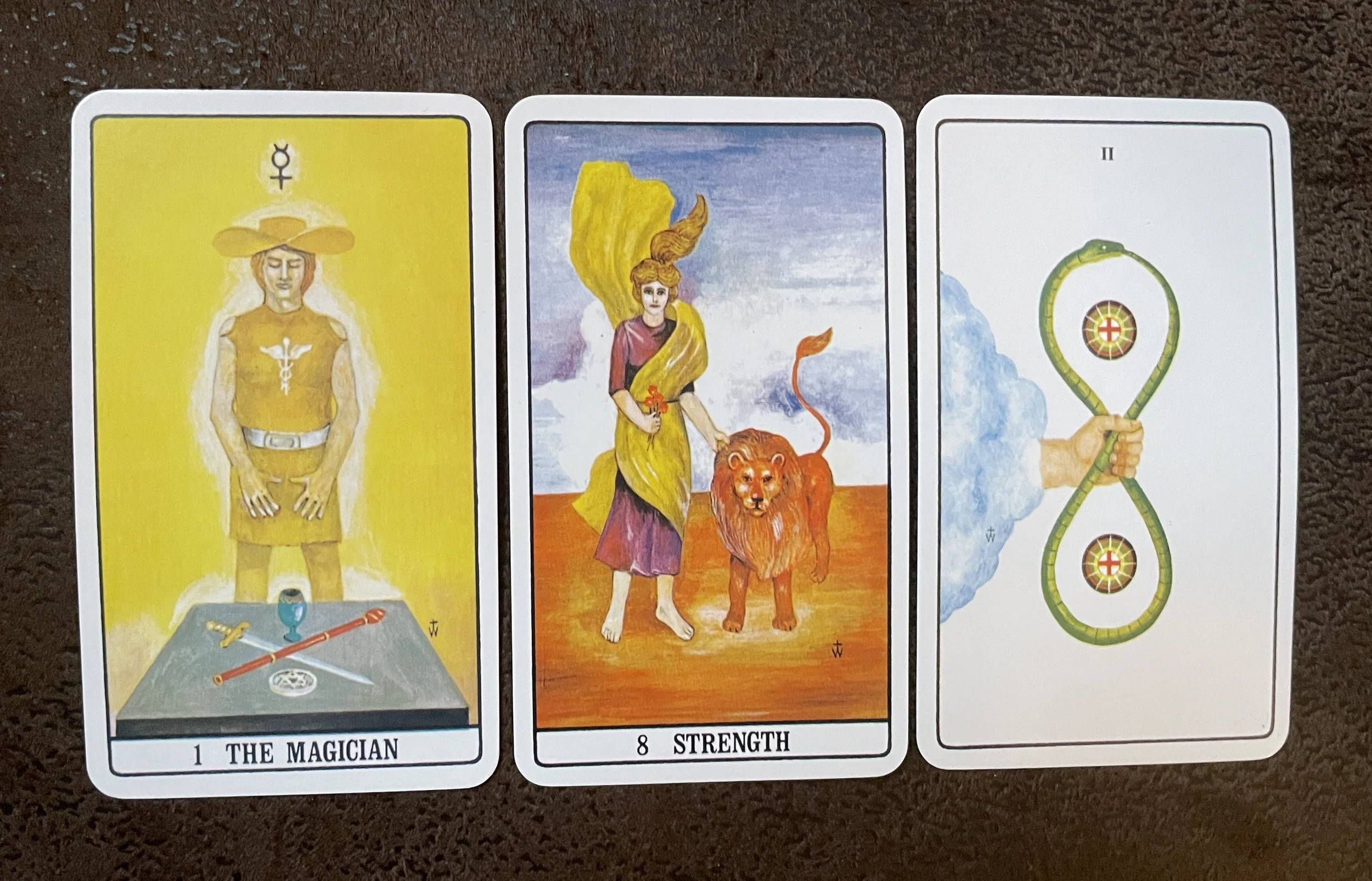
Golden Dawn Tarot, The Magician, Strength, 2 of Pentacles
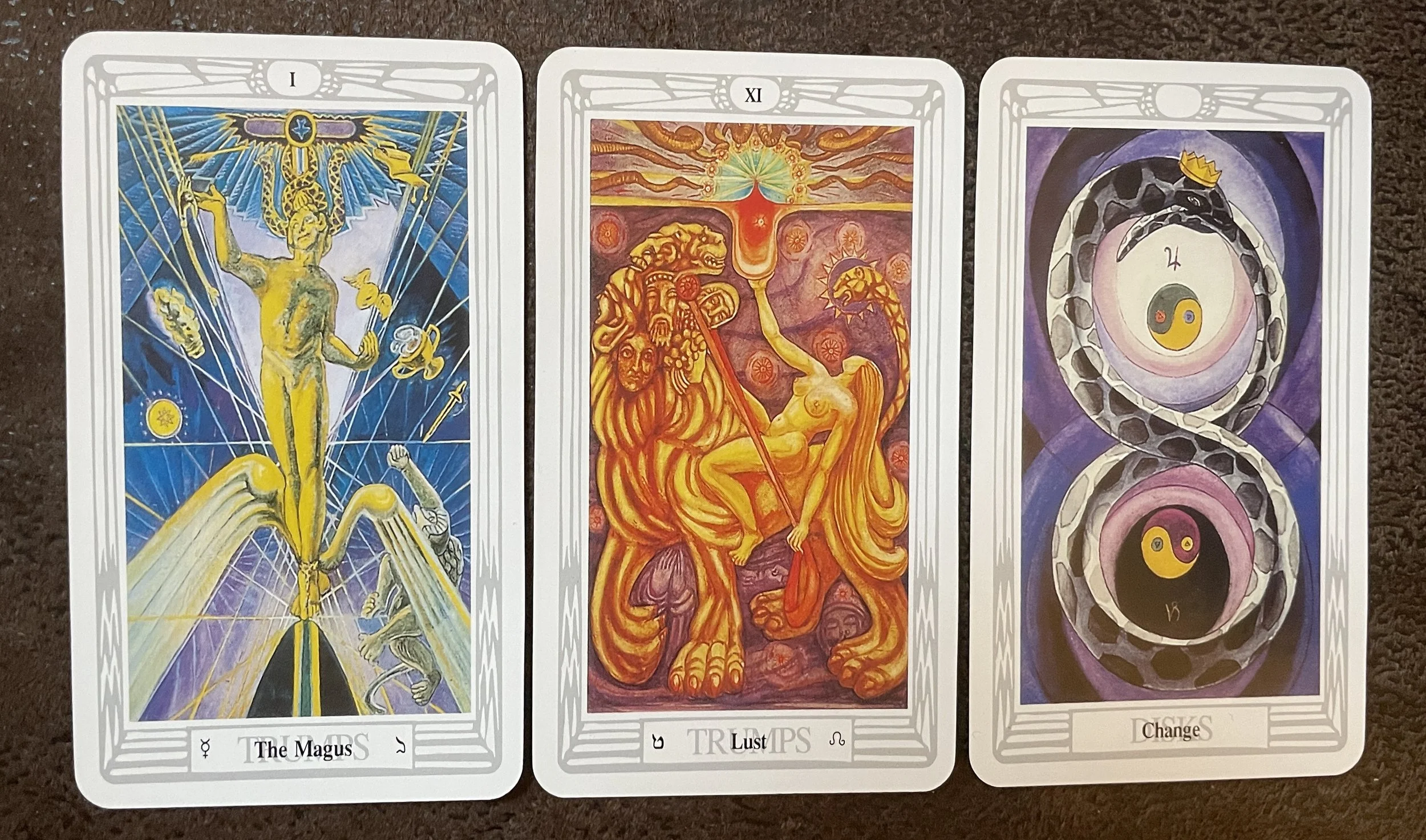
Thoth Tarot, Aleister Crowley, The Magus, Lust, Change
What the Lemniscate Means Now
The lemniscate appears on three cards in the RWS deck, the Magician, Strength, and 2 of Pentacles; and this is not accidental. The Magician is card I: the beginning of the Fool's journey, the time of pure potential, the will that sets everything in motion. Strength is card VIII (in the RWS ordering): the card of inner power, of mastering instinct through gentleness rather than force. 2 of Pentacles: represents balance (or lack thereof), adaptability, and managing multiple priorities amidst constant change and effort.
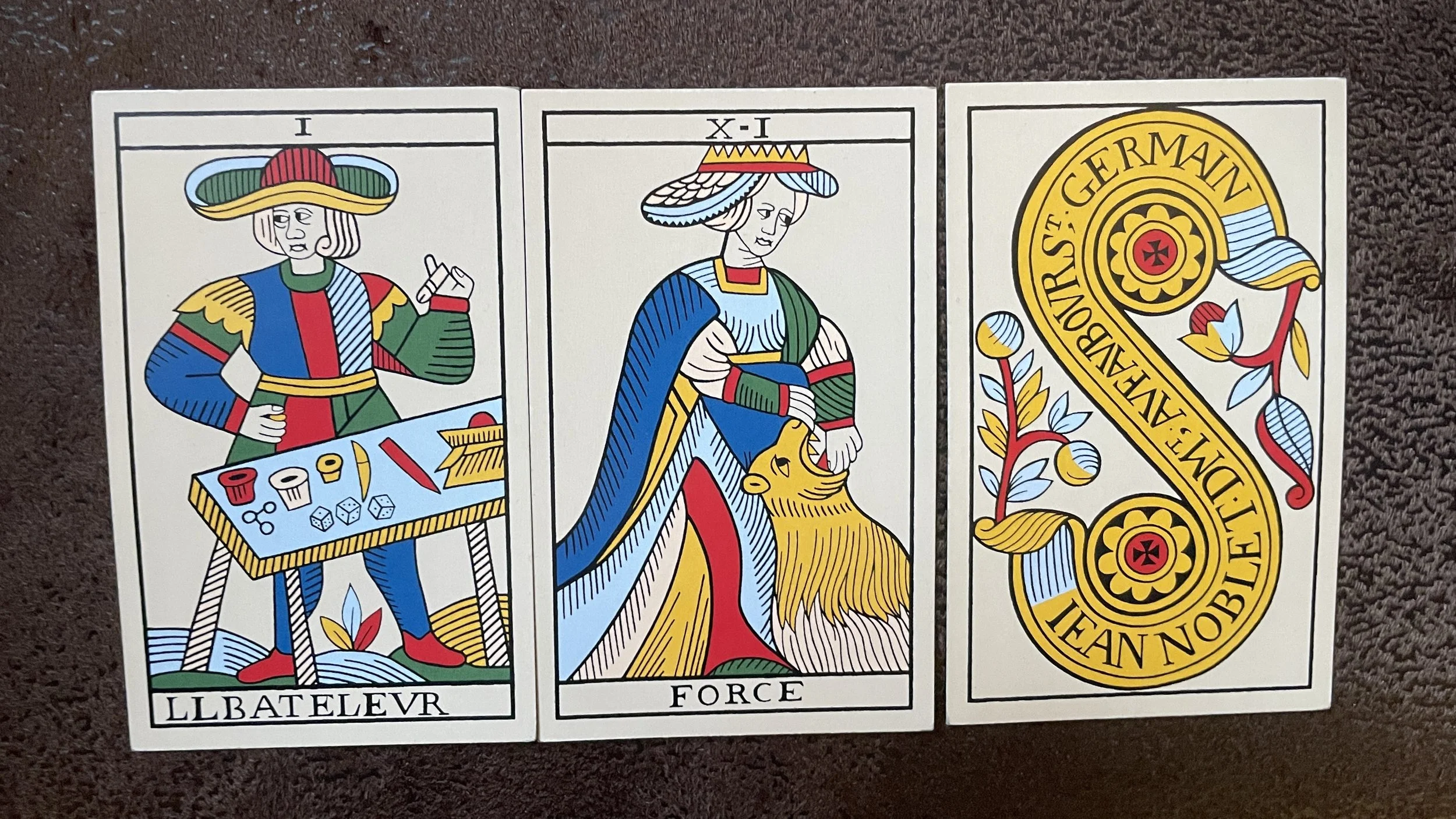
Tarot de Marseille, Jean Noblet version
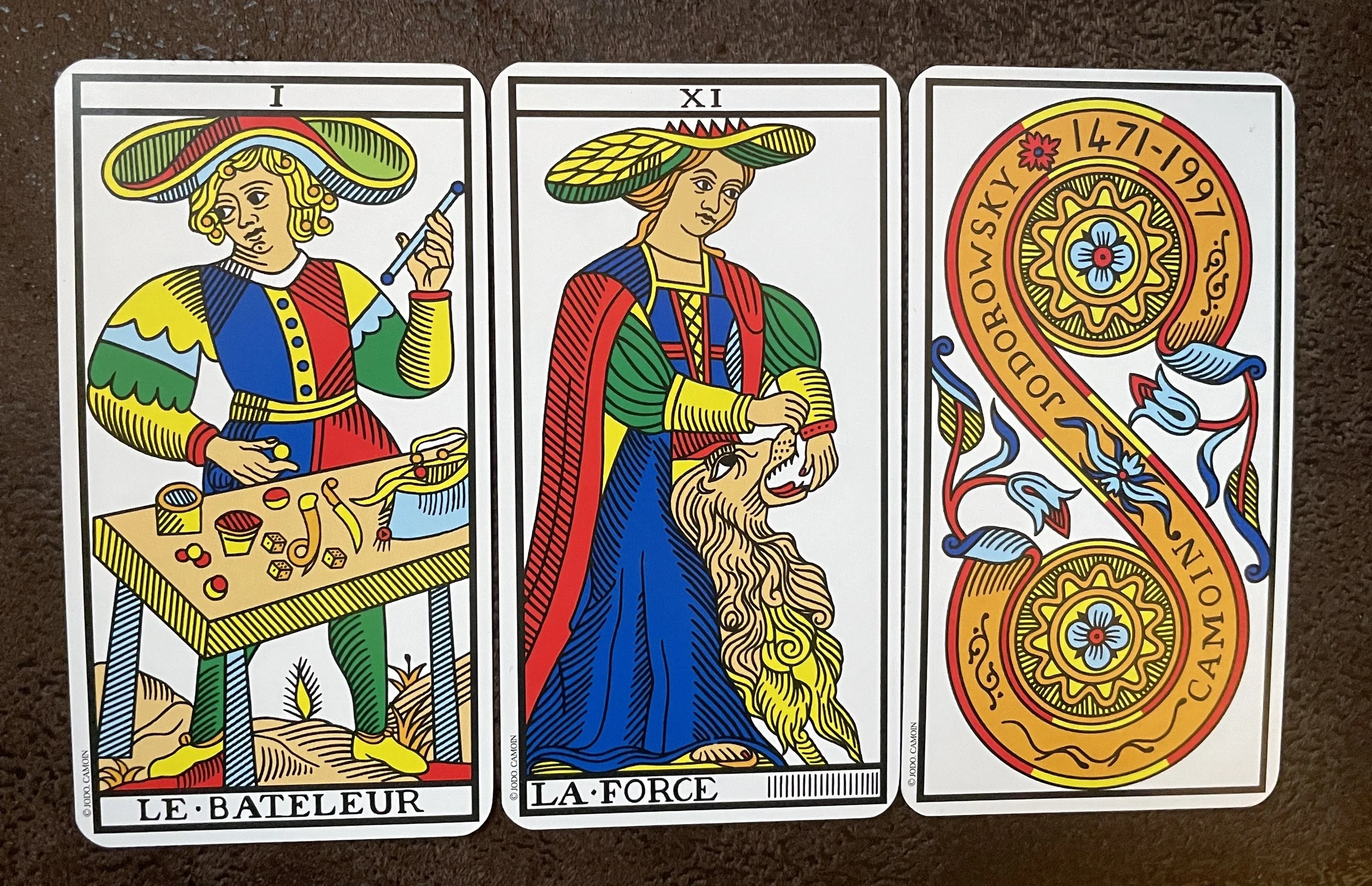
Tarot de Marseille, Jodorowsky-Camoin version
The symbol on these cards creates a visual connection in the deck: unlimited potential at the start, infinite inner strength in the middle representing a higher power, and for the minor arcana card 2 of Pentacles, more earthly priorities. The lemniscate links these cards, suggesting that the will to begin and the determination to continue both come from the same endless source. Modern readers tend to interpret the lemniscate in tarot as representing mastery over time, the revolving nature of energy, or the inexhaustible wellspring of inner power. These are readings that would have surprised the woodblock printers of 17th-century Marseille, who were simply putting a hat on a juggler. They are readings that would have delighted Eliphas Levi, who first saw the figure-8 brim as a sign of eternal life. And they are readings that Waite and Smith deliberately designed into the deck, encoded in a floating symbol that anyone, not just initiates of the Golden Dawn, could immediately recognize and feel.
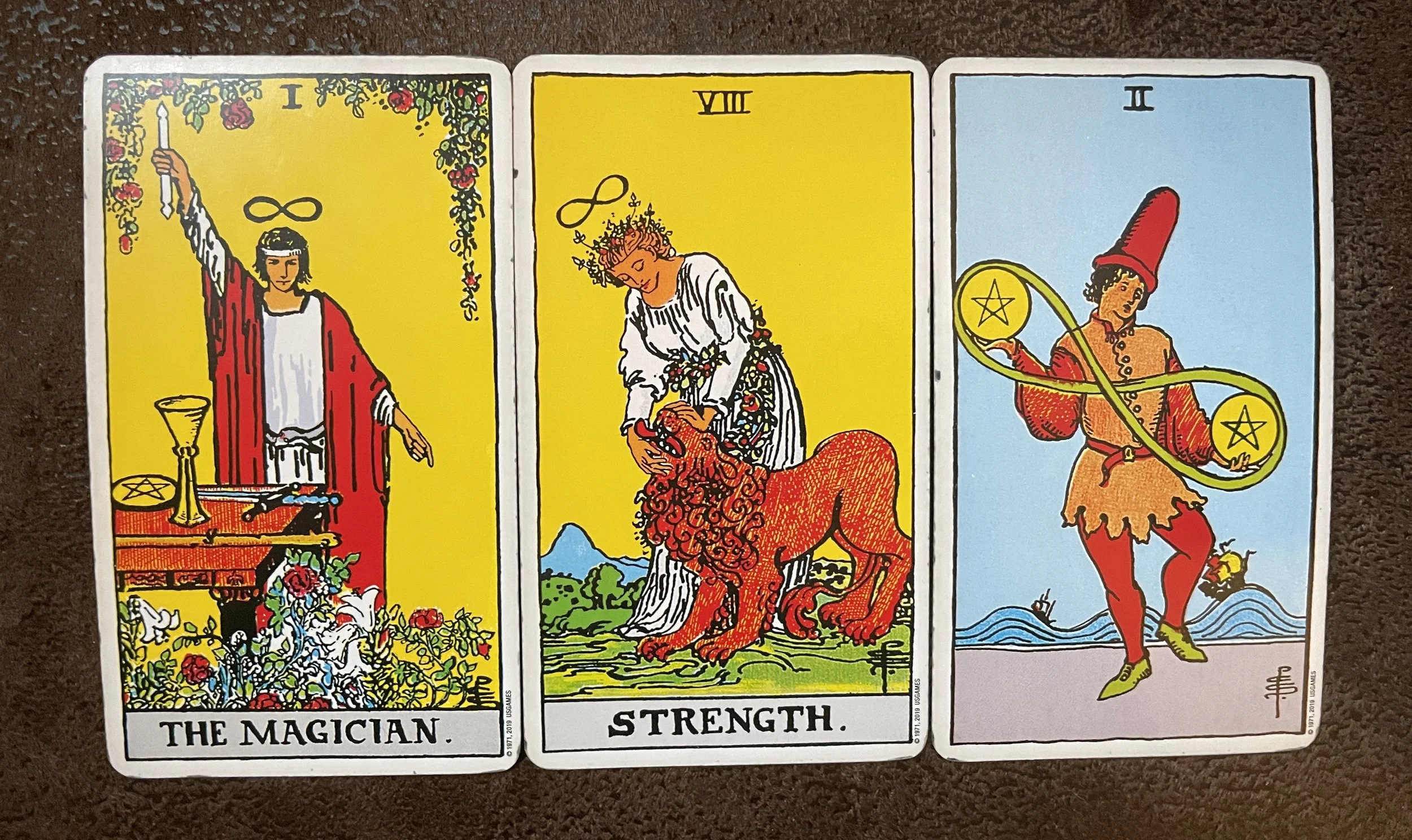
RWS Tarot
At first, the hat was just a hat. Then an occultist saw infinity in its shape. Later, an artist drew the symbol by itself, floating in the air, and it has stayed there ever since.
TIMELINE AT A GLANCE
Ancient world
Ouroboros and the Roman numeral CIↃ for 1,000 establish the figure-8 as a symbol of cyclical endlessness and vast quantity.
1655
John Wallis introduced the symbol ∞ in mathematics to denote an unbounded quantity, likely inspired by its Roman numeral form.
c. 1650–1800
The Tarot de Marseille standardizes Le Bateleur (I) and La Force (XI) with figure-8 hat brims — a costume convention, not esoteric symbolism.
1855
Eliphas Levi explicitly reads Le Bateleur's hat brim as a lemniscate — the sign of infinite will and eternal life. The Juggler becomes a Magus.
1889
Oswald Wirth redraws the Marseille deck under Levi's influence, making the lemniscate visually explicit on both Le Bateleur and La Force.
1909
Pamela Colman Smith, directed by A.E. Waite, removes the hat entirely and floats a freestanding ∞ figure above the Magician (I) and Strength (VIII). Waite controversially moves Strength from XI to VIII, lining up its number with the lemniscate shape.
20th century onwards
The RWS template becomes the dominant tarot model. The floating lemniscate is inherited by hundreds of decks and becomes one of tarot's most recognized symbols.